How a long-vacation football tournament became a vehicle for environmental citizenship, training, income and climate adaptation
On Saturday 12 September 2026, the League Pro final at Oyack Rail was not played on the pitch alone. A few hundred metres from the ground, eight fishponds dug by hand by local residents are still waiting for their first fingerlings. Between the two lies a simple idea: neighbourhood sport is not merely entertainment — it is the last fixture that still brings a whole neighbourhood together, year after year.
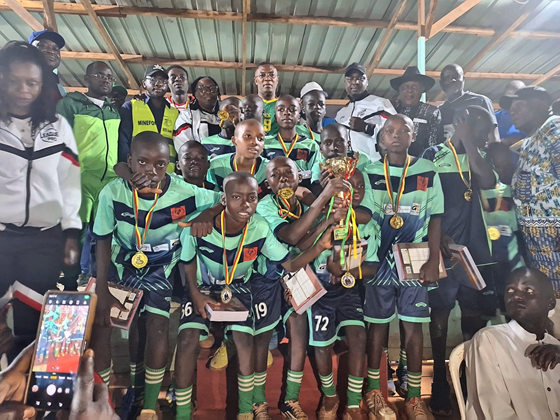
Two months of competition, one closing night
For nearly two months of the long vacation, the Oyack Rail League Pro drew several thousand people in the Yaoundé 5 City Council area. Nine senior clubs of fifteen players competed; four youth categories — U9, U11, U13 and U15 — brought in the youngest players. The tournament was held under the high patronage of Mr Augustin BALA, Mayor of the Council.
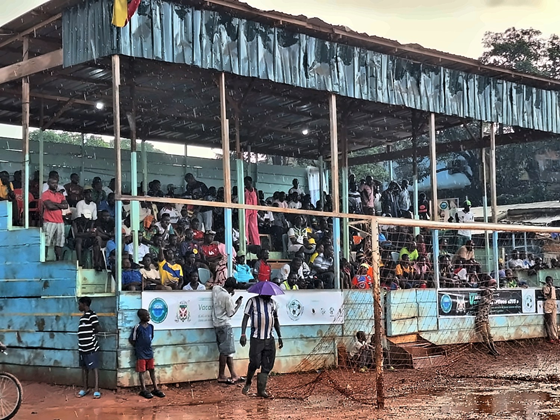
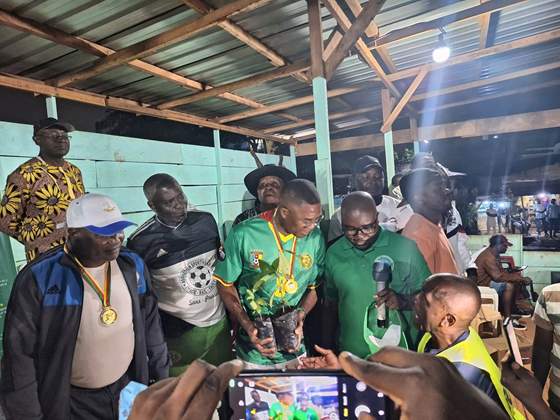
The closing ceremony at the Oyack Rail stadium awarded 800,000 CFA francs to the league winners and 400,000 CFA francs to the cup winners. The one hundred and twenty youth-category finalists received school kits — satchels, slates, exercise books and supplies — five days after the school year opened on 7 September. The presidents of the nine clubs and the refereeing corps, including several women who officiated throughout the season, were also honoured. A horseback parade opened the evening ahead of kick-off. The ceremony closed with the symbolic presentation of some fifteen tree seedlings to the Mayor and to the organising committee of the League Pro tournament.
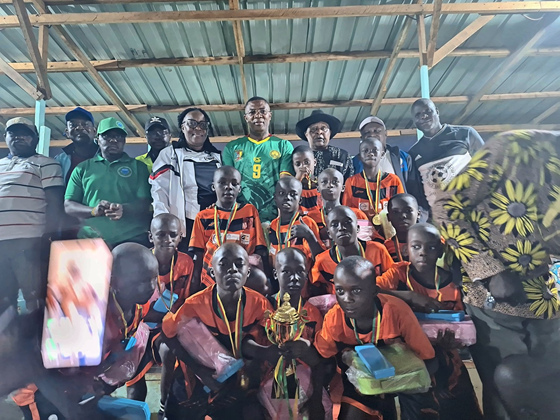
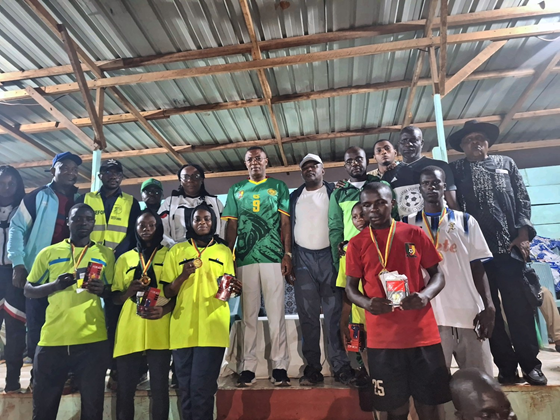
“Holiday tournaments are a way of guiding young people: through sport, but also through civic education. That is why the City Council sponsors every tournament in Yaoundé 5.” Mr Augustin BALA,Mayor of the Yaoundé 5 City Council
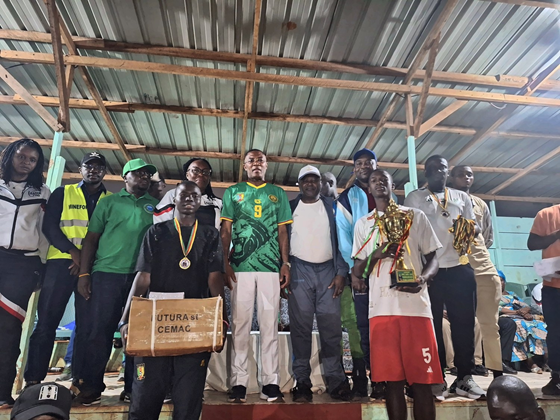
“This is the League Pro’s second edition, with one major innovation: opening it up to the youth categories. Everything unfolded in peace and harmony. My thanks go to the club presidents, the teams, the referees, our partners and those wonderful supporters who brought the tournament to life.” Mr BIAMOU NYAMSI, promoter of the Oyack Rail League Pro
Sport as a doorway, not a backdrop
This is where the Cameroonian Youth for Climate Action association (Jeunesse Camerounaise pour l’Action Climatique, JCAC) comes in, as a partner of the tournament under its Green and Sporting Holidays (Vacances Vertes et Sportives, 2VS)programme — an initiative recognised by the Ministry of Youth Affairs and Civic Education. The premise of 2VS fits in a sentence: rather than building a new awareness-raising platform that nobody will attend, attach yourself to the one that already exists and already works — the long-vacation tournament.
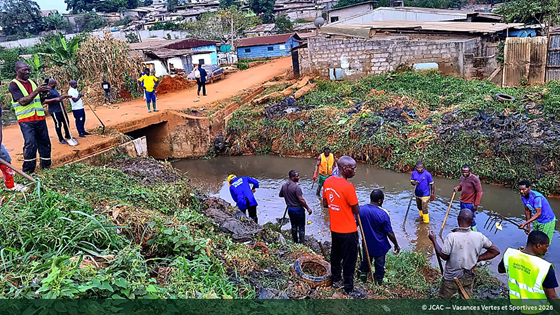
In practice, sport is not the decor of a campaign; it is its entry point. Close to a thousand messages on hygiene and sanitation were broadcast around the matches, during and after play. River-clearing operations were carried out on the Minlo with local residents, on a Sunday, from the earliest hours of the morning. Above all, the tournament’s audience made it possible to identify and then select the young people who would go on to be trained.
From the training room to the pond
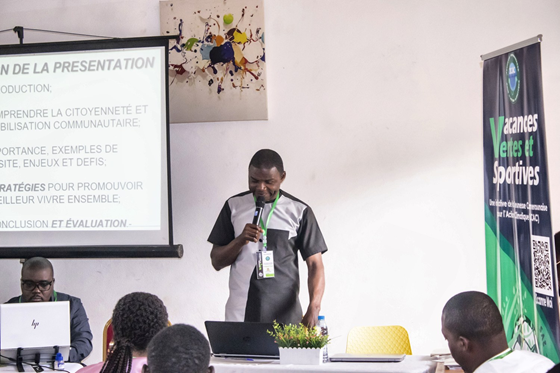
During the programme’s second edition, in 2025, a workshop on citizenship, the environment and youth empowerment was held at the Women’s and Family Promotion Centre, bringing together community actors, tournament promoters and representatives of government departments. In all, some thirty young people were trained in tackling urban disorder and pollution, in civic engagement and community mobilisation, and in fish farming — with technical support from the Ministry of Housing and Urban Development (MINHDU), the Ministry of Youth Affairs and Civic Education (MINJEC), the Ministry of Environment, Nature Protection and Sustainable Development (MINEPDED) and the Ministry of Livestock, Fisheries and Animal Industries (MINEPIA).
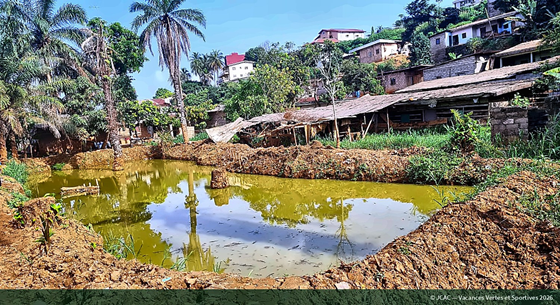
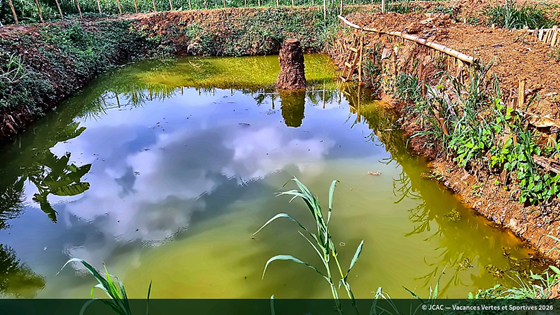
The training did not stop in the classroom. In its wake, in the wide marshland running alongside the Minlo river — until then a dumping ground and a source of recurrent flooding and waterborne disease for neighbouring households — eight ponds of roughly 100 m² each were dug and filled by the beneficiaries themselves. Since 2025, spending has reached 3,189,500 CFA francs, entirely self-financed by the association and local residents. With no stocking, the basins stayed empty; for this third edition they had to be refurbished in anticipation of the fingerlings and feed still awaited.
One intervention, four returns
The strength of the scheme lies in a single piece of infrastructure delivering several effects at once. Each pond is a retention volume that blunts flood peaks: that is climate adaptation, paid for by residents’ own labour. The site, now maintained year-round, is no longer a dump: that is public sanitation. The young people who run it earn an activity and an income: that is employment. And the fish produced stays in the neighbourhood: that is food security.
In time, the initiative is to become a community fish-farming centre of thirty ponds, with a hatchery, a feed production unit, green spaces, a training area and a point of sale, capable of producing close to 240,000 fingerlings a year. A five-year business plan has been drawn up and discussions are under way with several partners.
“Cameroon is a great sporting nation, and holiday tournaments are everywhere. Most end with a prize-giving. We want to go further: to turn these tournaments into a moment of citizenship, of climate action, and of launching development initiatives that go on inspiring and uniting people long after the final whistle — initiatives that change people’s lives while protecting nature.” — Alain Blaise NGONO, President of JCAC
What still needs to happen
Two pieces are still missing. The fingerlings and feed that were announced have not reached the beneficiaries: the eight basins, dug at the end of the 2025 training and refurbished this year, hold water but remain empty; one production cycle has already been lost, and every season that passes tests the patience of people who gave their labour and their own resources. JCAC and local residents are still waiting for MINEPIA’s donation of fingerlings and feed; discussions are continuing. The temporary occupancy title for the site, requested from the Council, is also awaited: it conditions both the security of the investment already made and access to financing.
The third edition is over. What matters now is to ensure that what worked at Oyack Rail no longer depends on the determination of one association and one neighbourhood. JCAC is advocating the adoption of a national set of specifications — three pages, five obligations — that would give every holiday tournament organised in Cameroon an environmental and civic component. Three editions make a proof of concept; the task now is to make it a standard.
Cameroonian Youth for Climate Action (JCAC) — Green and Sporting Holidays (2VS) programme, third edition, in partnership with the Yaoundé 5 City Council.
Contact: jcacassociation@gmail.com — +237 652 066 178 / 675 484 680 — www.jcac-cm.org